

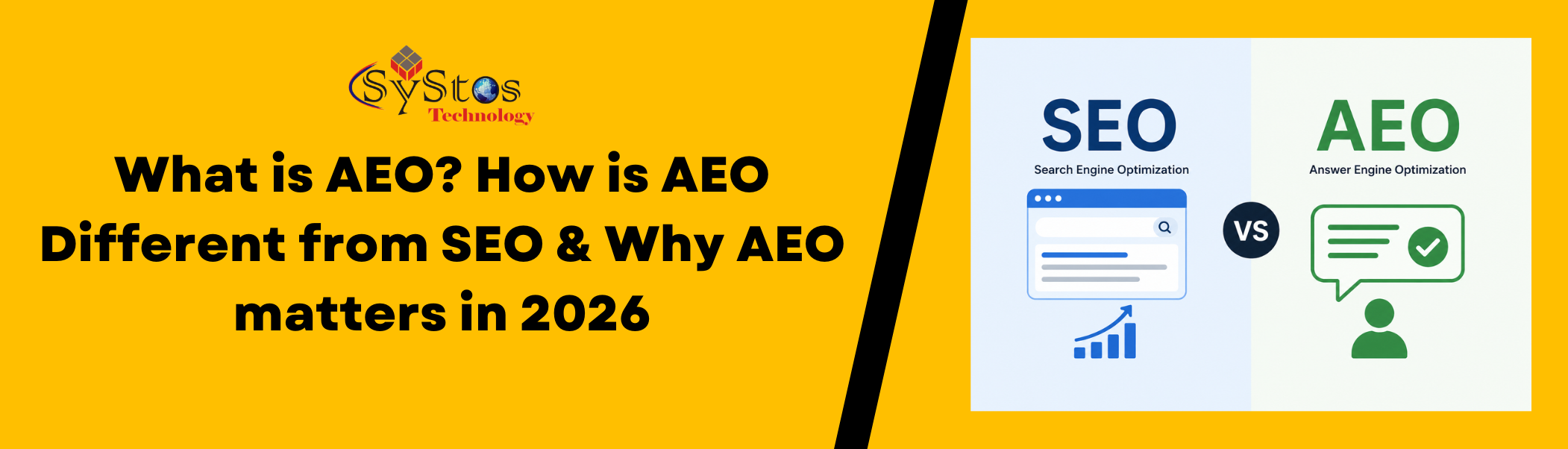
There is a strange shift happening in search right now and it does not feel loud like past algorithm updates. It feels more like something slipping in through the side door. Traditional SEO is still there of course but something else is sitting on top of it. That something is AEO or Answer Engine Optimization. A few teams at SyStos Technology in India started noticing this change in client data sometime late last year. Rankings were fine but clicks were acting differently. Traffic patterns felt off in a way that was hard to explain at first.
AEO is not exactly new but it is becoming unavoidable in 2026. The way people search has changed. People are not just typing keywords anymore. They are asking things. Full questions. Sometimes messy ones. Sometimes very specific. And search engines or AI tools are not just showing links anymore. They are giving answers directly. That small change has bigger consequences than it first appears.
AEO is about making content that answers questions directly so that search engines or AI systems can pull that answer and show it without forcing users to click through. It is not about ranking a page as much as it is about becoming the answer itself. That sounds simple but it changes how content is written and structured.
At SyStos Technology there was this one project for a local service business where the page was ranking well for a competitive keyword. Still traffic dropped. It turned out Google was showing a full answer box above the result and users were just reading that and leaving. The content was good but it was not shaped like an answer. After rewriting parts of it into direct responses to actual user questions things slowly improved. Not dramatically but enough to notice.
SEO has always been about visibility in search results. Keywords backlinks technical health things like that. AEO feels more like visibility inside the answer itself. Instead of asking how to rank number one the question becomes how to be the source that the engine trusts enough to quote.
There is also a subtle shift in intent. SEO often works around keywords even when it tries to match intent. AEO starts with intent and then ignores keywords unless they naturally fit. Content becomes less about density and more about clarity. Sometimes shorter answers perform better than long detailed pages which feels a bit counterintuitive after years of long form content advice.
Another difference is where the content shows up. SEO is mostly about search engine results pages. AEO extends into voice assistants, chat interfaces and AI generated summaries. That means the format matters a lot more. Clean sentences, clear structure and direct responses seem to get picked up more often.
The biggest reason is simple. People want faster answers and they are getting used to not clicking links. That changes everything. If content is not part of the answer layer it risks becoming invisible even if it technically ranks.
There is also the rise of AI driven search tools. These systems do not just list results. They synthesize information. So they pick content that is easy to extract meaning from. That is where AEO comes in. Content that is structured around questions and clear answers has a better chance of being used.
At SyStos Technology there was some hesitation at first. It felt like giving away information without getting clicks in return. But then again if users never click anyway it makes more sense to at least be the source of that answer. There is still some debate around this. Not everyone agrees fully but ignoring it does not seem like a good option either.
SEO is not disappearing. It is just changing shape. Technical SEO still matters. Site speed still matters. Authority still matters. But those things are becoming more like entry requirements rather than differentiators. AEO sits on top of SEO rather than replacing it entirely.
Think of SEO as making sure the door is open and AEO as deciding what happens when someone looks inside. Without SEO content might not even be found. Without AEO it might be found but ignored in favor of a direct answer from somewhere else.
There is also this hybrid space where both work together. A page might rank and also provide the snippet that gets featured. That seems to be the sweet spot right now.
Content that feels like it is written for actual people asking real questions tends to perform better. Not overly polished, not stuffed with keywords just clear and slightly conversational. It helps when the answer appears early in the paragraph instead of being buried somewhere in the middle.
At SyStos Technology there was a small experiment with FAQ style content. Instead of long sections with vague headings the content was broken into question based chunks. The answers were short but complete. That seemed to increase the chances of appearing in featured snippets and AI summaries.
Another thing was that overly complex language did not help. Simpler sentences worked better. Not simplistic but easier to process. That might be because AI systems prefer clarity over creativity when extracting answers.
There is also something about trust signals. Content that includes specific examples or small real world details feels more reliable. Even if it is not perfect it seems to resonate better with both users and algorithms.
This is where things get interesting. AEO might actually level the playing field a bit. Large companies still have authority but smaller businesses can compete by being more precise and more relevant in answering niche questions.
A local business does not need to compete on broad keywords. It can focus on very specific queries that bigger players might ignore. That is where AEO becomes useful. It rewards relevance over scale to some extent.
At SyStos Technology there were cases where smaller clients started appearing in answer boxes simply because their content addressed a very specific question clearly. It did not always translate into massive traffic but it did improve visibility and credibility.
There is still some uncertainty about how far this can go. Big brands still dominate in many areas. But the gap feels slightly narrower than before.
There is something slightly uncomfortable about optimizing content for answers instead of clicks. It feels like giving away value upfront without knowing what comes back. That hesitation is understandable.
But the shift is already happening whether it feels comfortable or not. People are adapting quickly. Search engines are adapting even faster. Content strategies probably need to catch up.
Picking up from where things were left off, the shift toward AEO does not really come with a clear instruction manual. It is more like a slow realization that the old way of doing things still works, just not in the same predictable way anymore. Some teams adjust quickly. Others hold on to SEO habits that used to work perfectly fine a year ago. Neither side is completely wrong, which makes it slightly confusing.
At SyStos Technology, there have been moments where two similar pages performed very differently even though both were optimized well in traditional terms. One had clean keyword targeting, solid backlinks, proper headings. The other one was simpler, almost plain, but structured around actual user questions. Strangely, the second one started getting picked up in AI generated summaries more often. Not always, but enough to raise eyebrows internally.
Search engines now behave less like directories and more like interpreters. They try to understand what the user is asking and then piece together an answer from multiple sources. AEO content fits into this because it is already shaped like an answer.
Instead of scanning an entire page and guessing relevance, the system can lift a clear response directly. That reduces effort on the engine side, which probably explains why this format gets favored. There is still some mystery around how exactly different platforms choose their sources, and honestly, not everything feels consistent yet.
There have been cases where a smaller blog with a very direct answer outranked or outperformed a more authoritative site simply because the answer was easier to extract. That does not happen every time, but it happens enough to notice a pattern forming.
Short answer, yes, it can. And that is part of the discomfort around it.
When answers are shown directly in search results or AI tools, users may not feel the need to click through. That means fewer visits even if visibility is technically higher. It feels a bit like being seen but not engaged with.
At the same time, there is another side to it. Being the source of an answer builds a kind of silent authority. Users may not click immediately, but the name sticks. Over time, that recognition can turn into direct searches or conversions through other channels. Not guaranteed, but observed in some cases.
At SyStos Technology, a few clients saw traffic dip slightly after optimizing for AEO, but branded searches increased later. That suggests people remembered the source even if they did not click right away. It is not a perfect tradeoff, though. Some industries may feel the loss more than others.
It is less about format and more about intent, but there are some patterns that keep showing up.
Content usually starts by answering the question immediately. No long introductions or unnecessary context. Just a direct response. After that, it can expand a bit, add an explanation, maybe an example.
Paragraphs tend to be shorter. Sentences are clearer. There is less fluff, though not completely stripped down either. It still needs to feel human, otherwise it becomes too mechanical and might not connect well.
At SyStos Technology, writers sometimes rewrite the same paragraph two or three times just to make it slightly clearer. Not more impressive, just clearer. That small difference seems to matter more in AEO than it ever did in SEO.
There is also a tendency to include natural variations of questions within the same piece. Not forced, just how people actually speak. That seems to increase the chances of matching different query styles.
It is still useful, just not in the same rigid way.
Keywords now feel more like clues rather than targets. They help understand what people are asking, but the final content does not need to revolve around exact phrases. Instead, it focuses on answering the broader question behind those keywords.
For example, instead of targeting a single keyword like best digital marketing company, content might address questions like how to choose a digital marketing company or what makes an agency reliable. Those are closer to how users actually think.
At SyStos Technology, keyword tools are still used, but more for gathering question based queries rather than finding high volume terms. It is a subtle shift but changes the entire approach to content planning.
Adoption feels uneven. Some companies are experimenting actively, while others are barely aware of the shift.
In India, where digital competition is already intense, AEO creates both pressure and opportunity. Businesses that rely heavily on organic traffic are starting to notice changes in user behavior. That usually pushes them to explore new strategies.
SyStos Technology has been gradually introducing AEO practices into existing SEO workflows rather than replacing them completely. That seems to work better than a sudden shift. Clients are more comfortable with gradual changes.
There is also a growing interest in voice search optimization, especially in regional languages. That connects closely with AEO because voice queries are almost always question based. This area still feels underdeveloped, which might mean more room for growth.
One common mistake is trying too hard to sound authoritative. Overly formal or complex answers tend to lose clarity. Simpler explanations usually perform better.
Another issue is ignoring context. Giving a direct answer is important, but it still needs to make sense within a broader explanation. Otherwise, it feels incomplete.
Some content also becomes too repetitive when trying to cover multiple question variations. That can make it awkward to read. Balance is important, though it is not always easy to get right.
At SyStos Technology, there have been drafts that looked perfect structurally but felt unnatural when read aloud. Those usually needed revision. AEO content still needs to sound like something a person would actually say.
It does not feel like a temporary trend. If anything, it seems like the early stage of a larger shift.
Search is becoming more conversational. Interfaces are becoming more interactive. Users expect immediate responses. All of that points toward AEO becoming more central over time.
There is still uncertainty around how monetization and traffic models will adapt. If fewer users click on websites, businesses will need to rethink how they measure success. Visibility alone might not be enough.
Still, ignoring AEO does not seem like a realistic option anymore. It is already shaping how information is delivered online.
What is AEO in digital marketing?
AEO stands for Answer Engine Optimization. It focuses on creating content that directly answers user questions so search engines or AI tools can display those answers instantly without requiring users to visit a webpage.
Is AEO replacing SEO completely?
Not exactly. SEO still plays a foundational role in visibility and indexing. AEO builds on top of it by shaping content in a way that makes it easier for engines to extract and present as direct answers.
Does AEO work for small businesses?
Yes, sometimes even better. Smaller businesses can target very specific questions and niche queries, which increases their chances of appearing in answer boxes or AI summaries without competing on broad keywords.
Why is AEO important in 2026?
User behavior has shifted toward quick answers and conversational queries. Search engines now prioritize direct responses, making AEO essential for maintaining visibility in modern search environments.
Can AEO improve conversions?
It can, indirectly. While it may reduce clicks, it builds trust and recognition. Users who see consistent helpful answers from a brand may return later or search for it directly, leading to better long term conversions.
